The material decisions on a custom microfiber cloth — weight, weave, edge finish — get most of the attention, but the choice that surprises buyers most often is how the artwork actually gets onto the cloth. Microfiber behaves nothing like a cotton tee or a paper coaster, and the print method you pick quietly sets the rules for everything else: which cloth colors you can use, whether your logo can be photographic or has to be flat spot color, how low your order can go, and how long production takes. Settling that decision at the start of a quote saves a round of surprised emails later.
Start with the fiber: microfiber is a sublimation-first material
Almost all cleaning microfiber is polyester, or a polyester-polyamide blend, and polyester is the one fiber that dye sublimation was built for. In sublimation the printer lays your design in reverse onto a transfer paper, then heat and pressure turn the solid dye into a gas that bonds directly into the polyester fibers. The color becomes part of the cloth rather than a layer sitting on top of it. That distinction matters for a cleaning product specifically: a surface ink film can glaze over the fibers and blunt the very texture that lets microfiber lift dust and smears. Because the sublimated dye penetrates instead of coating, even a full-coverage print leaves the cloth working the way an unprinted one does. It is also why sublimation is the default for full-color and photographic artwork — the process lays down all colors in a single pass with no separate screen per color, so gradients, photos, and complex logos cost no more to print than a one-color mark.
The catch is contrast. Sublimation only shows up well on white or light cloths, and it cannot print white at all — anywhere your design is meant to be white, what you actually get is the base color of the cloth showing through. If your brand mark is white on a dark background, sublimating it onto a dark microfiber will not reproduce it. The usual fix is to print the art on a white or light-grey cloth and let the fabric itself read as the light part of the design.
When screen printing or a woven option still makes sense
Screen printing lays ink on the surface, one screen per color. On microfiber that carries two consequences worth weighing. First, it can print opaque colors — including white — on dark cloths, which is exactly what sublimation cannot do, so a white logo on a black or navy cloth is a screen-print or heat-transfer job by definition. Second, the cured ink sits on top of the fibers, so within the printed area the cloth loses some of its softness and absorbency. For a small logo in one corner that is a non-issue; for a large graphic covering a lens cloth it can matter. Screen printing also carries a setup cost per color, so a one- or two-color mark stays economical while a full-color photograph becomes impractical.
Two other routes come up. Heat-applied transfers behave much like a screen print for these purposes — good for white or spot-color marks on dark cloths, and a film on the surface. And for a premium, tactile finish some buyers add a woven or embroidered patch, or a printed care-label style tag, rather than decorating the cloth face at all, which keeps the entire cleaning surface intact. Each of these is a legitimate answer. The point is to pick the one whose trade-offs you can live with before anyone approves artwork.
Specify the artwork so it survives the method
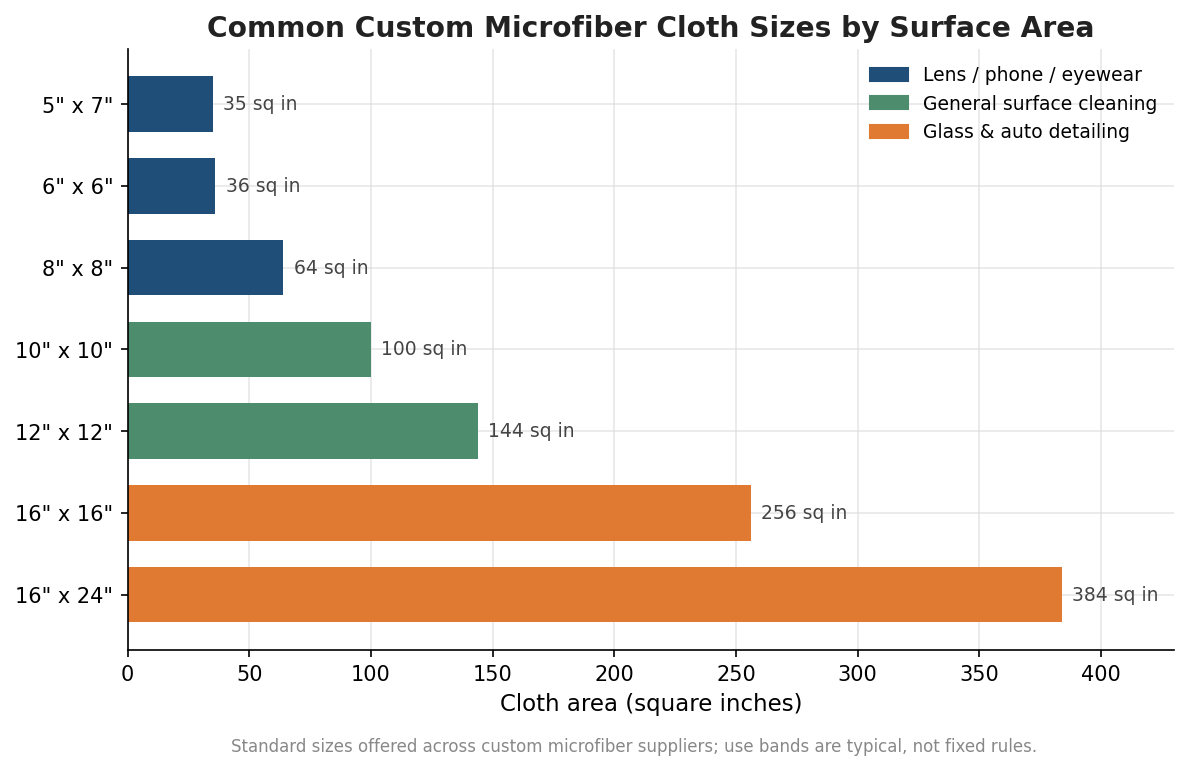
Match the art to the method, not the other way around. If you are sublimating, build the design on a light background, drop any element that relies on white ink, and keep small text a touch heavier than you would for paper, because very fine lines can soften slightly as the dye spreads into the fibers. If you are screen printing, count your colors — every additional spot color is another screen and another setup charge — and convert your logo to the specific spot colors you want rather than leaving it as a photo. In both cases supply vector artwork where you can, confirm whether the print runs one side or two, and ask for the maximum imprint area at the cloth size you chose, since decoration rarely runs edge to edge.
Quantities, setup, and where the price breaks fall
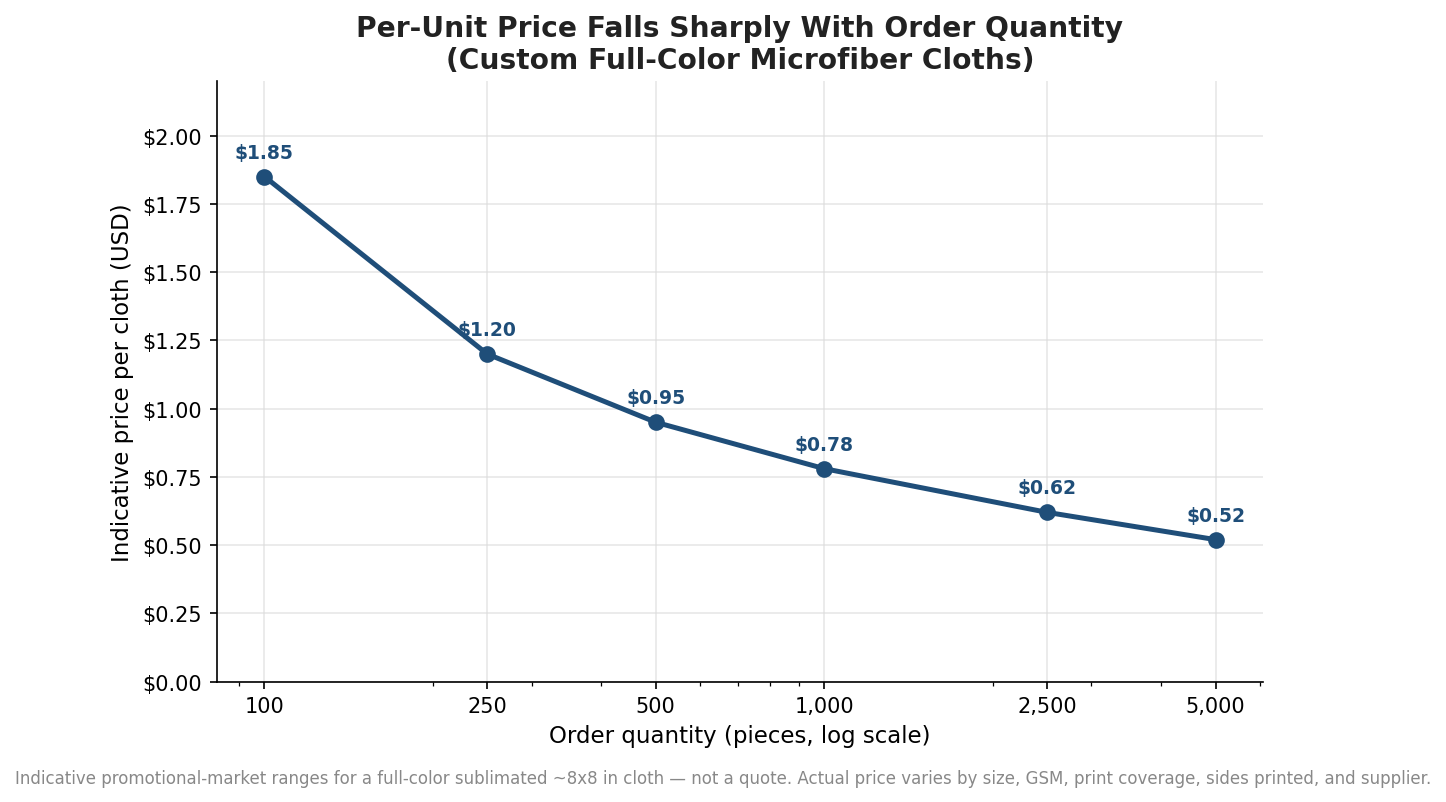
Minimums for custom microfiber vary more than most buyers expect. Full-color sublimated cloths are often available at low or even no minimum through digital, print-on-demand suppliers, while promotional-catalog programs commonly set floors somewhere around 75 to 250 pieces depending on the style and edge finish. Per-unit pricing across the promotional market runs roughly from under $0.50 for large-quantity budget cloths to around $3.50 or more for small runs of larger, heavier, two-sided prints. The clearest pattern is the volume curve: bulk orders in the 250-and-up range frequently land under a dollar a piece, and the per-unit cost keeps easing as you push into the thousands. Screen-printed jobs load their setup cost up front, so at low quantities a one-color screen print and a full-color sublimation can price surprisingly close, with sublimation pulling ahead on value once the artwork has more than a color or two. Treat the figures here as indicative of the market rather than a specific quote — size, GSM, print coverage, and supplier all move the number.
Build the timeline backward from proofing
Standard production for decorated microfiber typically runs somewhere in the three-to-fifteen business day range once artwork is approved, with rush tiers — including one- to three-day options on some stock styles — available at a premium. The step buyers underestimate is proofing. Ask for a digital proof, and if color fidelity matters to your brand, a physical pre-production sample, because sublimated color on textured polyester can read a little differently than the same file does on a screen or on paper. If the cloths are tied to an event or a product launch, work backward: event date, shipping transit, production window, then proof approval, and give that proof step real room. A day spent confirming that a light-grey cloth reproduces your logo the way you expect is far cheaper than reprinting a few thousand pieces.
None of these methods is universally best. The right specification falls out of two questions answered honestly up front: what colors does the artwork actually need, and what color is the cloth going to be. Answer those, and the method, the minimum, and most of the cost picture follow on their own.