Microfiber all looks the same in a photo, which is exactly why buyers get burned. Two cloths at the same price and the same size can behave nothing alike: one lifts fingerprints off a lens in a single dry pass, the other pushes the oil around and leaves lint behind. The difference lives in a handful of specifications that rarely make it onto a product listing. If you are ordering custom microfiber cloths, whether as lens wipes to hand out or cleaning cloths to sell, knowing those specs is the difference between a cloth people keep and one they toss.
GSM is the first number that matters
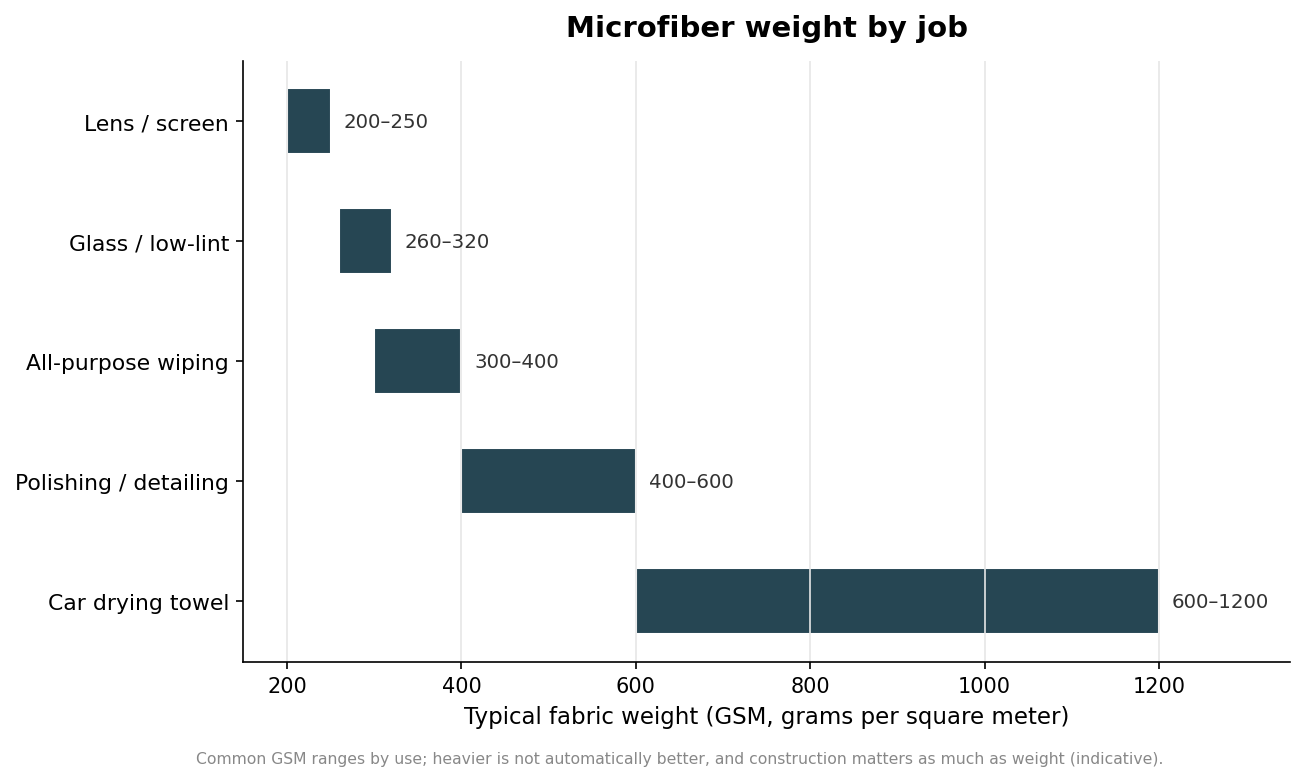
GSM, or grams per square meter, measures the fabric’s weight and roughly tracks its thickness and absorbency. It is the fastest way to sort a cloth to its job, even though it is not a quality score on its own. Thin cloths in the 200 to 250 GSM range are built for screens, lenses, and eyeglasses, where a light, fast-drying wipe is the goal. Move up to 260 to 320 GSM for glass and general low-lint cleaning, 300 to 400 for all-purpose dusting and damp wiping, and 400 to 600 for softer polishing and detailing. Heavy drying towels for cars climb well past 600 and can reach 1200 or more.
The common mistake is treating heavier as better. A 600 GSM plush towel is wrong for eyeglasses, where it is bulky and slow, just as a 220 GSM lens cloth is wrong for drying a car hood. Pick the weight for the surface first, then judge everything else within that band. A promotional lens cloth and a kitchen cloth are different products that happen to share a fiber.
The blend: polyester scrubs, polyamide grabs
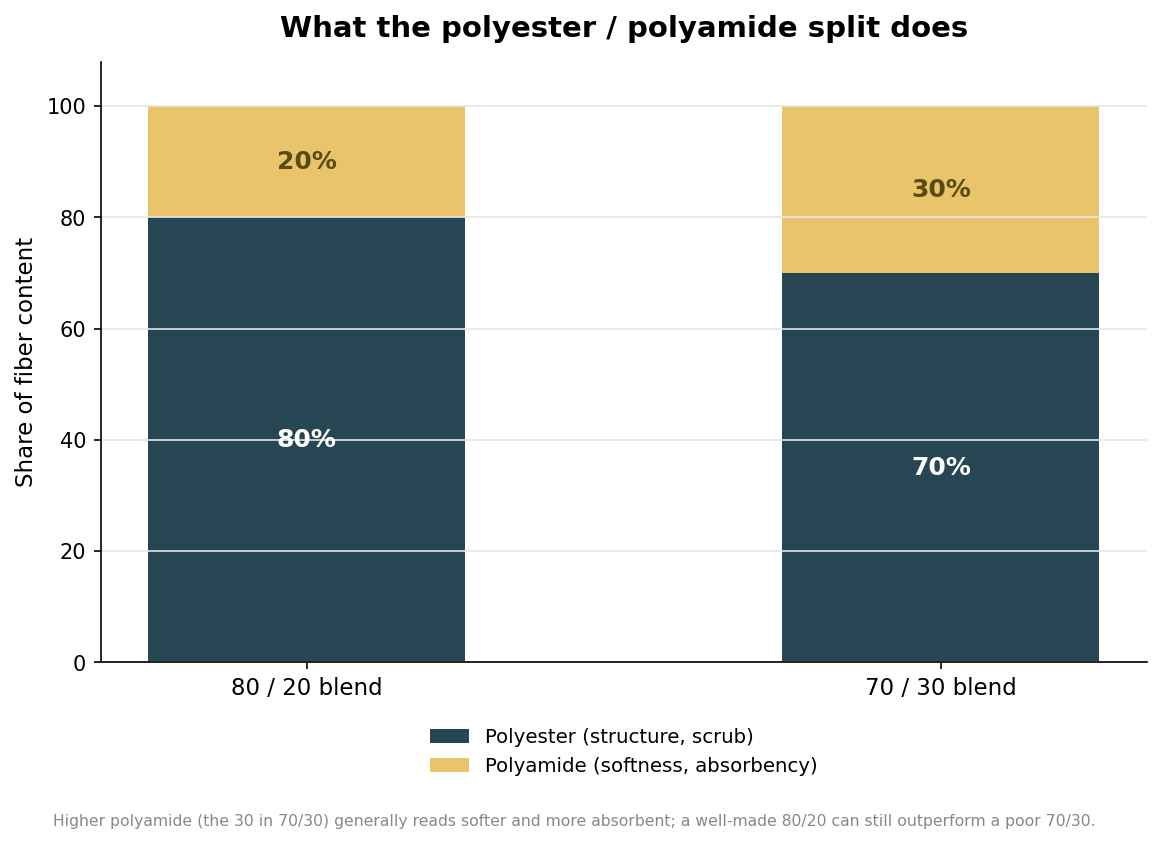
Microfiber is a blend of polyester and polyamide, and the ratio tells you what the cloth is tuned for. Polyester, the larger number, supplies structure, durability, and scrubbing bite. Polyamide, the smaller number, adds softness and boosts absorbency. The two ratios you will see most are 80/20 and 70/30. A 70/30 cloth usually feels softer and more absorbent, which suits delicate surfaces like coated glass and automotive paint, while 80/20 is a common, capable all-rounder.
Do not read the ratio as a verdict, though. A well-engineered 80/20 glass cloth can outperform a poorly made 70/30, because weave and fiber splitting matter at least as much as the blend on paper. Treat the ratio as one input among several rather than a headline stat, and be wary of listings that advertise the blend but stay silent on everything else.
Split fiber is where cheap and good part ways
The single biggest quality divide is whether the fibers are split. Splitting the fiber during manufacture multiplies its surface area and the number of contact points that grab dust, oil, water, and fingerprints. A properly split cloth feels faintly grippy on clean glass and lifts marks; a poorly split one feels slippery, slides across the surface without picking anything up, and can smear oil or shed lint. That tactile grip is the tell, and it is invisible in a product photo.
There is a simple field test. On a clean, dry pane of glass or a screen, a good microfiber should catch very slightly and reduce or remove a fingerprint with no liquid at all. A cloth that glides frictionlessly and leaves the smudge is under-split, whatever its GSM or blend claims. When you evaluate samples before a custom run, run this test rather than trusting the spec sheet alone.
Edges, size, and fiber fineness
The edge finish decides whether a cloth is safe on your most delicate surface. Overlock or serged edges have a stitched border that is fine for general cleaning but can scratch coated screens and paint. Ultrasonically cut edgeless cloths have no stitched border and are preferred for final polishing, coated glass, and car paint. Hard, rough stitching should be avoided on high-gloss and coated surfaces entirely. For a lens or screen cloth, an edgeless or soft-edge finish is usually worth specifying.
Size and denier round out the picture. Pocket lens cloths commonly run around six by seven inches, general cleaning cloths around twelve by twelve or sixteen by sixteen. Denier measures the fineness of each strand, and microfiber is defined as finer than one denier; strands in the 0.2 to 0.5 range capture finer particles than a coarser one-denier fiber of the same weight. As with GSM, denier is a useful input, not a standalone promise, since construction still governs how the finished cloth performs.
Specifying a custom cloth without guesswork
Putting it together, a clean custom order names the job first and lets the job drive the specs. Decide the surface and pull the GSM band from it, choose a blend and confirm the fiber is well split, set the size, and pick an edge finish that matches the most delicate thing the cloth will touch. For a giveaway lens cloth that might read as a light 220 to 240 GSM, edgeless, split-fiber cloth around six by seven inches; for a resale cleaning cloth, a heavier 300-plus GSM square with a serged edge.
Decoration is the last layer, not the first. Full-color artwork is typically applied by dye sublimation, which bonds the ink into the fibers and holds up to washing, while simpler solid logos can be screen printed; the lighter, poly-heavy lens weights take sublimation especially well. Confirm the printing method and a wash-durability expectation with your supplier, and treat weights, sizes, and blends here as indicative starting points to verify against actual samples before committing to a run.